
Monarch butterflies, the AI-Act, physics of magnetic responance, and the ethics of being visible: they are all relevant for scaling AI in medicine across health care systems. On November 13th and 14th, AI Health Vienna brought together experts from law, ethics, biology, machine learning and medicine to discuss and find out.
You could skim across a bunch, but we went deep on everything, and it paid off. You need the speakers to do that, we had them, and we had a blast. Thanks to all the speakers and panelists!
Elisabeth Steindl opened the first session “Law & Ethics” with a discussion of the landscape and development of legislation around tools that use neural data to infer cognitive states in the EU. Tabea Ott discussed the ethics of predictive AI, and the connected relevance of the visibility of parts of the population. Gisela Ernst went into detail on reimbursement, DiGas, and the concept of getting an app on recipe. Tanja Spennlingwimmer gave an overview of funding opportunities during the build up of start-ups in the high-tech area.
The second session focussed on “From the idea to application”, a tour through the Viennese and Austrian environment for start-ups in the high-tech area. Birgit Hofreiter explained the i2c approach, and its success in turning academic ideas into start-ups, and students and faculty into entrepreneurs. Gerhard Zotter gave insights into how an institution such as BBG tries to look into the future by participating in international projects, and by interacting closely with start-ups to facilitate a broad participation in tenders. Elisabeth Reithuber showed the funding and support opportunities by WAW that can be critical in several stages of start-ups and their joint work with other partners. Finally, Gerhard Aigner gave in-depth analysis of the history and current state of the legal framework controlling healthcare in Austria. Stefan Hochwarter gave the first keynote on the topic of “Hospital at home - experience, evidence and recommendations”, and Markus Egger followed with a discussion of the current state of cyber sovereignty in European healthcare.

The second day was opened by Michaela Fritz and Georg Langs, to introduce Jorge Cardoso, In his keynote on the topic of scaling to millions of patients and real life heterogeneity, he explained how the connected hospitals and universities in the London area have impact on innovation and patient care, and that aside from solving ethics and legal, you need to disentangle the physics of magnetic resonance imaging from the signals of biology.
In four dialogues of AI and Medicine, teams of CAIM at MedUni Wien explained their approach to interdisciplinary research and development at the interface of machine learning and medical sciences. Roxane Licandro, Marlene Stümpflein and Gregor Kasprian showed how image analysis can be used to better understand very early brain development before birth, and how this results in tangible and critical diagnostic information for parents. Harald Kittler and Sebastian Hochreiter showed how foundation models in dermatology image analysis can support diagnosis - a critical feature if the alternative is an invasive biopsy. Dominik Roth from emergency medicine showed the range of problems that can be tackled with AI, and how the emergence department is a special environment where decision paths, and observations are compressed to few minutes or seconds. Hrvoje Bogunovic and Natasa Jeremic showed how machine learning helps to connect observations of the ocular vasculature and systemic disease, opening up completely new avenues of prevention and diagnosis.
In his keynote, Markus Müller, the rector of MedUni Wien drew the line from the age of enlightenment to reductionism, molecular medicine, and a future, where all life might be viewed as information. Peter Robin Diesinger connected artificial intelligence and biological intelligence, emphasizing that not all intelligence is situated in a brain with neurons, and that understanding the continuum from basic biological processes to networks and even societies is key to make advance in our understanding of intelligence.
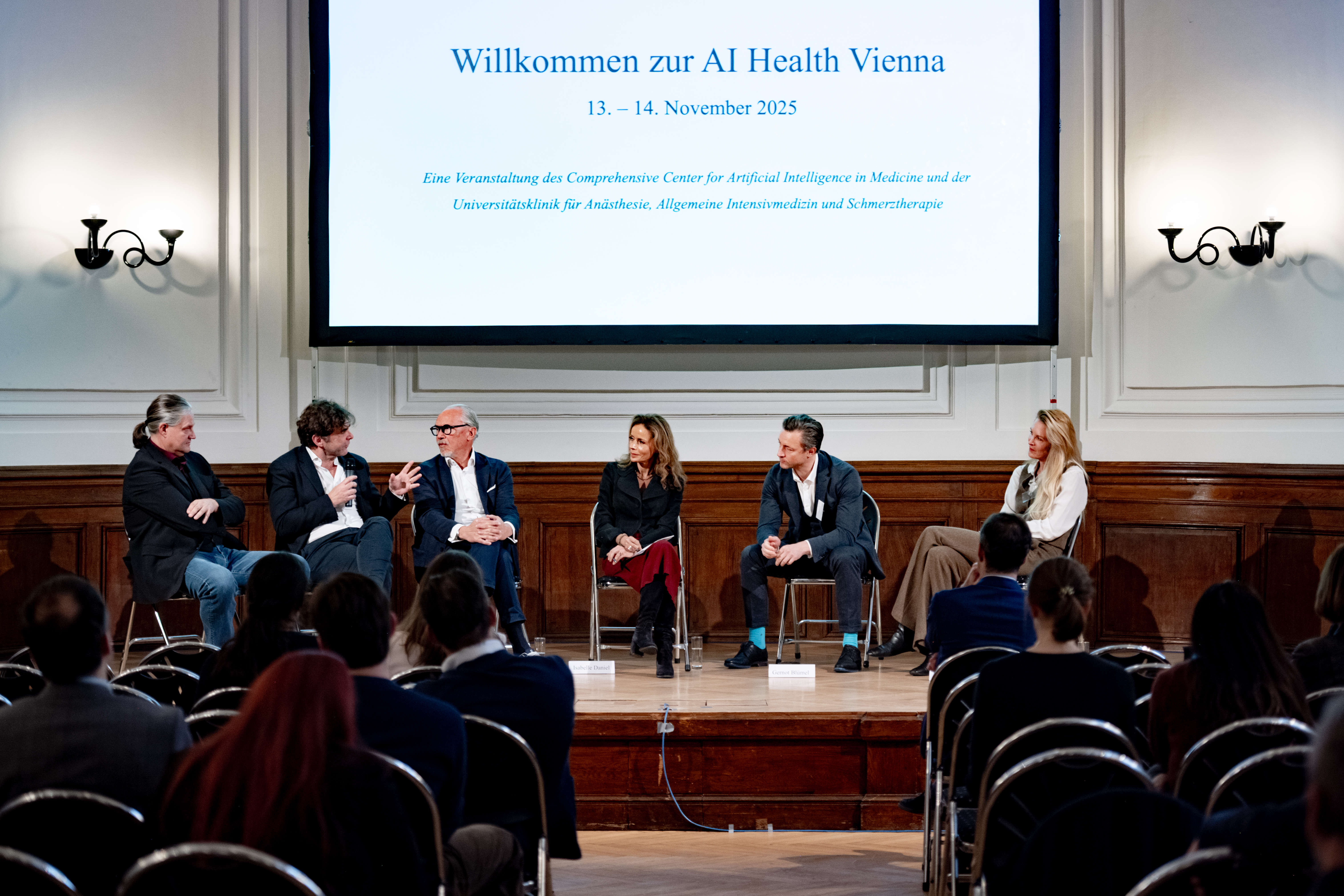
The symposium closed with a panel discussion on the topic of “Mensch, Maschine, Medizin - Aufbruch in das Zeitalter der KI” during which the participants Harald Kittler , Markus Egger, Siegfried Meryn, Gernot Blümel, and Eva Dichand went into controversial detail on topics involving the adoption of AI in key decisions, European positioning, and the risks and promises of data usage, AI and connected technologies.
Come back next year! ... stay tuned for the dates.
For the organizing team: Oliver Kimberger, Maria Kletecka-Pulker, Clemens Heitzinger, Georg Widhalm, and Georg Langs