
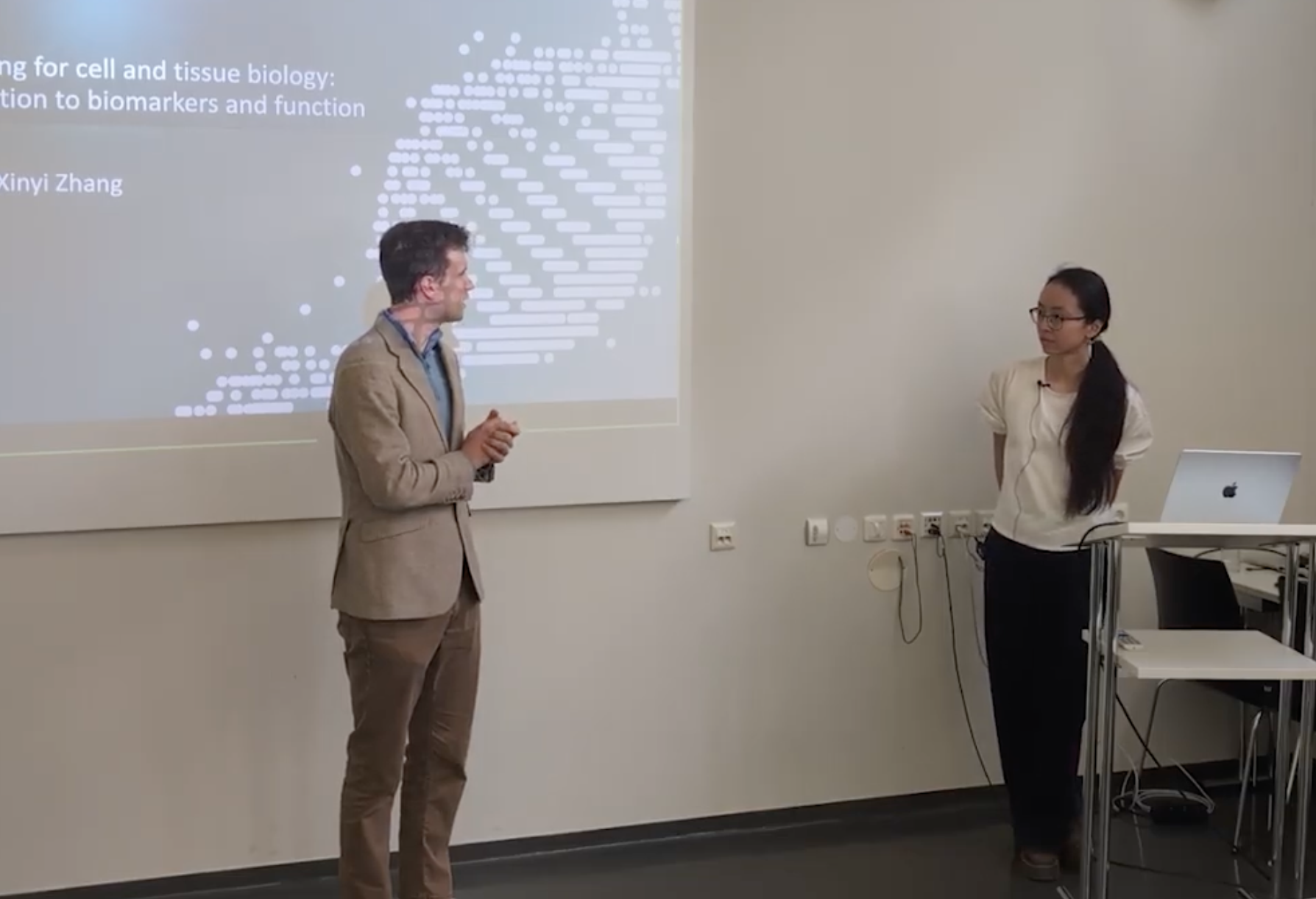
CAIM talk by Xinyi Zhang on machine learning and computational neuroscience
After activation, data will be sent to YouTube. Further information here: Data protection
Date: March 25th, 2026, 12:30 pm
Location: Medical University of Vienna, Anna Spiegel Research Building, Seminar Room Level 3
Speaker: Xinyi Zhang
Title: Representation learning for cell and tissue biology: from multimodal integration to biomarkers and function
Abstract: Biological processes involve complex interactions across scales. While experimental advances have enabled the measurement of multiple modalities in the same cells, a comprehensive understanding of cell and tissue states requires computational methods that can integrate these diverse data types. Additionally, multimodal data collection remains resource-intensive and technically challenging, limiting its application across large patient cohorts. Therefore, there is a need to not only integrate multimodal data but also to identify simple biomarkers that capture cell state information from a scalable modality. To address this, we developed computational frameworks to integrate diverse data modalities, including gene expression, the tissue microenvironment, and cellular imaging. Applied to an Alzheimer's disease mouse model, our approach reveals spatio-temporal disease progression patterns and associated nuclear morphological and transcriptional changes. Furthermore, we demonstrate that unsupervised analysis of chromatin imaging alone can identify cellular states predictive of pathology and morphological biomarkers in neurodegenerative disease samples. Recognizing that cellular images contain rich information, we developed PUPS (Predictions of Unseen Proteins’ Subcellular localization), which combines protein sequences and cellular images to predict the localization of unseen proteins in unseen cell lines with single-cell specificity. In addition to integration, we introduce an autoencoder framework with partially shared latent spaces that explicitly disentangles shared and unique information across modalities, which is important for understanding underlying cellular regulation as well as experimental design. Together, these frameworks advance our ability to integrate diverse modalities and identify scalable biomarkers, providing deeper insights into cellular states and disease processes from limited measurements.
Key papers:
- Zhang, X., Shivashankar, G. V., & Uhler, C. (2026). Partially shared multi-modal embedding learns holistic representation of cell state. Nature Computational Science. https://doi.org/10.1038/s43588-025-00948-w
- Zhang, X., Tseo, Y., Bai, Y., Chen, F., & Uhler, C. (2025). Prediction of protein subcellular localization in single cells. Nature Methods, 22, 1265–1275. https://doi.org/10.1038/s41592-025-02696-1
This is part of the CAIM Talks series.